
Patch #34: Dead water
Salvaging meaning from the lost world of Travis McGee's Florida

For perhaps the first time in my life I appreciated the corrosive effects of total uncertainty. And it was something I could use, if I survived to use it.
John D. MacDonald
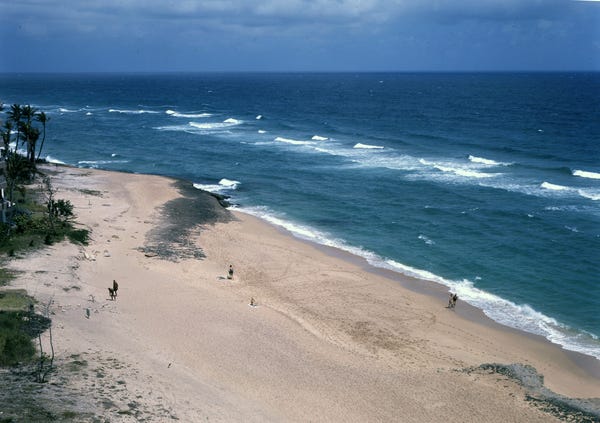
There are twenty-one Travis McGee novels written by John D. MacDonald. The series began with The Deep Blue Good-bye in 1964 and concluded with The Lonely Silver Rain in 1985. Prior to picking up my first McGee novel, it never occurred to me I would read all of them, but it increasingly seems I am doing just that—a project that is part procrastination and part something that I’m attempting to figure out by writing about it here. As a diligent believer in literary self-improvement and ardent follower of economics podcasts, I would like to read the Vasily Grossman novel Life and Fate, or maybe a more directly applicable nonfiction work about meditation and spirituality, or perhaps the latest hyperbolic AI manifesto, but I keep reaching for another Travis McGee novel, cozying up in the long-gone world of the drifting Floridian as he takes on another ill-advised mission to right the world’s wrongs one salvage operation at a time.
I find myself wondering about why these books so appeal to me at this moment. Are they, in the vein of Don Carpenter’s Hard Rain Falling, semi-Dostoyevskian masterpieces hiding in pulp clothing? Or are they just guilty pleasures—noir beach reads in possession of an appealing veneer of retro shtick? Maybe what I’m drawn to is the beachy escapism MacDonald infuses in every page, one that calls to mind the early 1970’s exploits of Tom McGuane, Jimmy Buffett, Jim Harrison, Richard Brautigan et al in the Florida Keys (captured so well in the short documentary All That Is Sacred). After a morning of Tarpon fishing, I write middling fiction while I watch the sun set through the swaying palm trees. Or maybe I do nothing at all, uninterrupted, for hours. I reach for my phone. There is no phone. A Catamaran slaps past, heading for the islands. “Sailing” by Christopher Cross plays on a tinny transistor radio. I could go on, but I would be even more embarrassed, as a middle-aged father with the usual responsibilities, by the unoriginal nature of my longings.
The vibes are evocative, but there’s something deeper here, something having to do with the central tension in the books between ambivalence and action—between the questioning inner life of McGee and his vexing need to keep engaging the outer world. I think this tension has a distinct flavor that smacks of our current moment; that we live in schlocky, dangerous, and confusing times; and that maintaining a line of sight on how to engage in reality while questioning it offers something like spiritual nourishment.
Some foundational explanations about the books are in order. Travis McGee is a middle-aged man who lives in the Bahia Mar Marina (slip F-18) in Fort Lauderdale aboard a lavishly appointed houseboat built by a lovestruck sport who couldn’t say no to his Brazilian bride. McGee won the boat in a poker game and subsequently coined it The Busted Flush. MacDonald doesn’t tell us much about McGee’s past. We know he was once a promising tight end, but his football career was cut short by a knee injury, that he’s a combat veteran, and that he had a role, never quite explained, in trying to overthrow the communist regime in Cuba. A rotating cast of marina regulars appear in the books, including the debauched Alabama Tiger, who lives a few slips down and maintains the world’s longest ongoing party, and frequent McGee sidekick Meyer, a hirsute, semi-retired economist who lives aboard a cramped cruiser named, in most of the books, The John Maynard Keynes.1
Each McGee novel has the same structure, which allows them to hang together as a series without necessitating a sequential reading. McGee works, irregularly, as a “salvage consultant” who finds things that have been lost and are difficult to retrieve. The terms of each engagement are the same. Should McGee succeed, he keeps half of the assessed value of the found objects and gives the rest to the individual who hired him. His assignments are often Florida-based, but he occasionally makes his way to New York City, Mexico, the Bahamas, Grenada, Hawaii, and even Pago Pago. MacDonald has many skills, but he’s especially capable at pillorying paradises of all shapes and sizes, wielding McGee’s singular inner voice like a scalpel.
Though you likely intuit it, it should be noted the salvage missions narrated in the books never quite work out to a mutually beneficial exchange of goods for services. For a relatively small fee, McGee is shot in the head, beaten to the point of hospitalization, and, in one memorable incident, nearly pushed into a pre-dug hole in an orange grove by a mustachioed politician driving a bulldozer. Even when he does succeed, McGee has a weakness for giving his hard-fought riches to others. When not working, he slowly spends his earnings until he runs out of money, a state that never actually occurs because new missions inevitably seek him out. The motivation for these salvage operations is often more moral than monetary: McGee frequently refers to himself as a Quixotean knight errant, foolishly rescuing lost causes from a world that grows ever more corrupt. In the face of such a truth, one might do something—however stupid—or they might do nothing. McGee always chooses to act.
It may be that McGee’s bias for action in the face of logic is what makes him so appealing as a character. In the latter part of his life, Ludwig Wittgenstein was drawn to pulpy detective novels, and we can intuit that the great philosopher recognized himself in the predilection of pulp heroes like Mike Hammer and Phillip Marlowe to prioritize practical engagement over abstract theorizing. In McGee, we find a similar approach to problem solving, a hands-on method that is less dazzling on the surface than, say, the preternatural genius of a Sherlock Holmes, but has the benefit of being far more relatable. Here’s McGee’s inner monologue as he considers a fresh look at his predicament in A Deadly Shade of Gold:
And so nothing had been as I had imagined. I had to let the structure fall down and then try again. I had to find a new logic. I was frightened without knowing why I should be. It was fright with a paranoid flavor.
The passage captures the qualities I love so much about McGee’s inner voice: a deadpan, brutally honest, often scathing running commentary that runs through all twenty-one books positions a messy inner journey—one with twists, turns, doubt, and backsliding that all ring true—as a parallel plot that paces alongside MacDonald’s efficient, event-driven pulp storytelling.
The competition between McGee’s ambivalent inner voice and his impulse to action in the external world gives the books a dissonance that’s hard to quite pin down. Early in the novels, we often find McGee more focused on his own state than any mission. Sometimes, he relishes the sun-fried hedonism of the Fort Lauderdale high life. He drinks gin, eats broiled steaks or chops, and talks too late into the night with Meyer while the sea rolls beneath their feet. He has short-lived flings with stewardesses, artists, shop-girls, heiresses, and everything in between. If he finds himself getting too fat, he resolves to swim every day and eat more cottage cheese. The sun sets. A go-go dancer from Honolulu puts an upbeat number on the hi-fi (Marantz, AR-3’s) and shimmies on the deck, her expression cool, confident, and intent. As readers, we know she’ll probably be dead in a week. Friends come by and drag everyone to a seaside restaurant. McGee orders shrimp scampi and a Carta Blanca and the flavors turn to library paste in his mouth. McGee ruminates on his dread. Restaurants, boats, people, fish, and the land itself are all shifting, contours altered by undulating shorelines and currents that betray the structures sitting on top of them. How long will it be until it all disappears for good?
When the offer for the next salvage mission comes, McGee jumps at the chance to distract himself. Soon, he finds himself driving, or flying, or crashing into waves on a seaworthy craft, and even though he should know better, his mood improves. Meyer cheers him on. Welcome back, my friend. It’s good to see you again. For a while there, you were acting like a salesman at a convention. But the pleasure, we know is fleeting. The land will not hold. Time will not stop. The developers will not suddenly change their minds, see the error of their ways, and stop building shoddy stucco monstrosities with wall-to-wall carpeting and views of the Atlantic. McGee’s inner monologue, as entertaining as it is, is just a finger in a breaking dam. The thing he fears most is surely coming, because it is coming for all of us. You can crack the case, but you can’t stop time. Remember that guy who used to live on the houseboat in F-15? What was his name?
These tensions and dynamics are unusual, especially in popular fictions. Our heroes are not supposed to sit around navel gazing and contemplating ontological mysteries; they are meant to do stuff. As James Hillman writes in Kinds of Power:
Because the movement of classic heroism is forward and upward, the most difficult of all tasks for heroic consciousness is looking inward into its own drive, the myth that propels it toward its cruel end: Hercules gone mad; Jesus crucified; Oedipus blind; Agamemnon murdered by his wife; Moses dead, away from the Promised Land.2
McGee constantly questions the myth of Travis McGee, and we love him for it. Conversely, we like him least when his inner voice becomes too confident, as it sometimes does when he opines about race or gender. The modern reader is likely to identify these vintage passages as cringy because, well, they are, but we shouldn’t lose sight of how unique McGee’s inner life is for a character who so often engages in action movie tropes.
It is a testament to the virtues of the books that attempts to turn them into movies fail so miserably. When we lose the uniqueness of McGee’s voice, we lose everything that makes the books unpredictable and narratively rewarding. McGee comes across as one-dimensional and forgettable, even as the filmmakers double down on the tropical atmospherics. Exhibit A is the unfortunate attempt to make Darker than Amber into a film in 1970.3 Here we have cardboard cutout McGee, going through the action hero motions without any of the beautiful nuance we find in the books. They even make poor Meyer wear a captain’s hat.
Unsurprisingly, John D. MacDonald despaired over the final result, calling it "feral, cheap, rotten, gratuitously meretricious, shallow and embarrassing.” By issuing his ruling the first time he was asked, I guess MacDonald saved successive reporters the trouble of asking him what he really thought.
In a 1983 attempt starring the venerable Sam Elliott, the mistake is to squeeze the inner voice into the ill-fitting pants of expository dialogue. The result is a brooding, boring McGee who exists without levity or self-questioning; a man who seems traumatized for opaque reasons rather than explicit ones. This is a view that sure has a lot of company in the realm of popular entertainment, especially when it comes to the heroes of action movies. Some vague background trauma, revealed in flashback, they do not want to talk about, serves as the suspect justification for a death wish. Think Rambo, Man on Fire, Sicario, and every Jason Statham character ever rendered.
McGee is no action star. He will never ride a motorcycle through the flames and emerge unscathed, or get shot and cauterize the wound without anesthesia. Some action stars grimace in pain and even limp, like John Wick, but they are rarely scared the way McGee is scared, and they never reflect on their brushes with mortality with anything other than determined stoicism.
MacDonald forces poor McGee to face his own mortality, and more than once. McGee’s scalp is shot off in The Empty Copper Sea. He is savagely beaten, almost to death, in A Deadly Shade of Gold. He’s stabbed with an ice pick inThe Quick Red Fox. He’s manhandled by Junior Allen in The Deep Blue Good-bye. And so on. MacDonald does not make light of these injuries. McGee strives to show resolve to his friends, but the inner voice reveals a questioning and fear of his life choices and an acknowledgement that his luck may be running out. Why would any sane person put themselves in the path of such pain? Will abandoning most attachments make you free, or will it make you dead?
As readers, we navigate our own tension between the desire for McGee to settle down and be happy and the desire for more adventures to keep us entertained. There’s another element too. McGee’s ambivalent relationship to ambition isn’t just made by his actions; it is consistently infused in the changing world of the novels themselves. The plotting of the books is consistently fast-paced and efficient, but it is in placing these narrative machinations against the natural beauty and fraught temporality of the Florida backdrop that makes the books so memorable. In particular, it is the wrestling with the speed of this transformation and the externalities of development that makes these novels notable given the time at which they were written. McGee regularly bemoans the relentless push for development, he notes the sterility of the homes where he finds himself; he worries about the inexorable drive for progress. His characters fetishize peaceful sojourns in quiet places where time has stopped, such as the undiscovered atolls left in the Bahamas.
The sensuality with which McGee describes the living world can only come from someone who understands its impermanence. Indeed, as Dwight Garner points out in his essay here, MacDonald was unusually prescient about the consequences of economic development on the environment. And it’s true that McGee frequently despairs at the state of the world around him, where short-term greed outweighs judicious consideration of long-term benefits. Take the following passage from Bright Orange for the Shroud:
In some remote year the historians will record that Twentieth Century America attempted the astonishing blunder of changing its culture to fit automobiles instead of people, putting a skin of concrete and asphalt over millions of acres of arable land, rotting the hearts of their cities, so encouraging the proliferation of murderous, high-speed junk that when finally the invention of the Transporlon rendered the auto obsolete, it took twenty years and half a trillion dollars to obliterate the ugliness of all the years of madness, and rebuild the supercities in a manner to dignify the human instead of his toys.
If MacDonald had just given us McGee’s memorable inner voice and cracking plots, it would have been notable. But by setting these elements into relationship with the consequences of growth at all costs, we get the ingredient that makes these books worthy of extensive reading. How do you take action when you’re filled with doubt? How do you reconcile a desire for solitude with a desire for connection? How do you love the natural world and watch it deteriorate at the same time?
The questions remain as relevant today as they were when MacDonald was writing the books. It’s worth asking if any of them were answered definitively by the author. MacDonald never consciously wrote the final McGee novel, but he did leave us with The Silver Rain before he died. The Florida of the book, written in 1985, has left McGee behind already. The drug dealers and smugglers are no longer tropical dreamers who want to sail the world and hide in unspoiled paradises; they’re cold-eyed, professionalized thugs in Armani suits. McGee finds himself a generation older than his peers. The crimes in Lauderdale feel more sinister and pervasive than they once did. While The Busted Flush and McGee’s powder-blue, converted Rolls Royce pick-up Agnes have held up due to McGee’s maintenance efforts, his runabout boat the Maniqueta requires attention. McGee wonders, with noted weight, if he has anything left in the tank. He is filled with regrets. He begins, for the first time, to see that his efforts to tightly control his context and shield himself from emotional vulnerability aren’t protecting him at all.
At times it seems as if arranging to have no commitment of any kind to anyone would be a special freedom. But in fact the whole idea works in reverse. The most deadly commitment of all is to be committed only to one’s self. Some come to realize this after they are in the nursing home.
MacDonald doesn’t tell us how to stop injustice or stop the destruction of the environment, but he does leave us with a humble meditation on how to exist in the world. Toward the end of the novel, McGee learns he has a daughter he didn’t know about from an affair in an earlier book. The daughter is hostile, but McGee is able to repair the relationship. In the book’s final scene, McGee finds himself at a party with friends, bragging to Meyer about his daughter’s SAT scores. Meyer has heard it all before three times, and lovingly points out what a bore McGee has become now that his heart is so filled with love and he’s stopped trying so hard to control things he can’t possibly influence. “Welcome to the world,” Meyer says. MacDonald didn’t intend it to be the last line of the McGee books, but it’s hard to imagine a more perfect one.
Recommendations:
Reading: If you’re interested in reading some McGee books, this list by Peter Swanson is a great place to start.
Listening: The La’s, by The La’s
Music credits for article audio:
Opening Theme: “Cepheid Disk” by Airglow via Wikimedia Commons
Closing Theme: “Comfort in Uncertainty” by bbatv via Wikimedia Commons
Upgraded to The Thorstein Veblin in later books. MacDonald’s critiques of [conspicuous] consumption, the leisure class, and greed are consistent throughout the books.
Hillman, James. Kinds of Power. Doubleday, p. 14.
I watched it so you don’t have to.